OPEN THE HEAVENLY GATES WITH SINGING! BY STUDENT RABBI MIRIAM FARBER

The Chasidic rebbe Shneur Zalman of Liady taught, “There are gates in heaven that cannot be opened except by melody and song.” This Friday night, we will have the special opportunity to pray together with extra song and melody. Some of the community’s talented musicians will join me in leading our Kabbalat Shabbat service. I hope you will come and join us, adding your voices (no talent required!). It’s been a pleasure and an honor to pray and learn with you all this year. Thank you for welcoming me into your community and into your homes.

CONGRATULATIONS, DON AND HELEN CHERRY

Mazal Tov! Don and Helen’s son, Doug, who got married this past February, is being promoted to Colonel in the Army. This promotion makes him his father’s superior officer …

STUDENT RABBI MIRIAM FARBER’S LAST VISIT – MAY 10-12

Student Rabbi Miriam Farber’s last official visit to Great Falls will be Mother’s Day week end, May 10-12. Please mark your calendars and plan to attend Friday evening services, Saturday morning Torah study, and the milchig (dairy) potluck/adult discussion Saturday evening. The schedule follows.

  • Friday evening, 05/10/2013: Shabbat services led by student Rabbi Miriam Farber, 7:30 P.M. at The Bethel *
  • Saturday morning, 05/11/2013: Torah Study, led by Student Rabbi Miriam Farber, 10:00 A.M. at the Bethel *
  • Saturday evening, 5:30 P.M. Milchig (dairy) Potluck and Adult Discussion at the Bethel. * Please bring a dairy dish to share.

Todah Robah to the following Congregation members who have offered their hospitality to Student Rabbi Miriam Farber and to provide the oneg for this coming week end:

  • 05/10/2013 Airport Pickup: Marty Foxman
  • 05/10/2013 Friday evening dinner: Don and Helen Cherry
  • 05/10/2013 Friday evening Oneg: Stephen Boyd and Joy Breslauer
  • 05/11/2013 Saturday lunch: Laura Weiss

This is the last time we will meet together as a community until the High Holy Days. We have so much to celebrate together — the coming of Spring, the fact that Israel exists, the fact that we are and can still be Jews in Montana of all places, learning to love and trust God more every day, learning and passing on the teachings of Torah to our children, and strengthening the ties that bind us together as families and as a community, and as a people specifically chosen by God to bless the rest of the world. What a wonderful heritage to share with each other and to pass on to our children. Let’s take this time and every time we get a chance to be uniquely Jewish to celebrate it and to kindle or rekindle the lights of Shabbat in our hearts.

* Bethel Lutheran Church, 1009 18th Ave SW

For directions or more information, click about us above.

NOTICE OF PUBLIC MEETING THIS COMING TUESDAY, 04/30/2013

EDITOR’S NOTE: This week the congregation mailbox received a letter from Cascade County, informing us of a public meeting on this coming Tuesday, 4/30, in the Courthouse Annex, regarding stormwater related issues in the Gibson Flats. As our cemetery and property are located in that area, our congregation is part of the public notice process.

NOTICE OF PUBLIC MEETING

Cascade County hereby gives notice, pursuant to Section 76-15-103, MCA, that it will hold a public meeting for the purpose of discussing stormwater related issues within the Gibson Flats area as part of the ongoing storm water study to seek solutions to drainage concerns in the area. The public meeting will allow engineers from Big Sky Civil & Environmental, Inc. to discuss existing problems, corrective alternatives considered, alternative costs, environmental impacts, potential funding scenarios, and other aspects evaluated in the Preliminary Engineering Report (PER) document. Public attendance and participation is encouraged in discussions of developing viable solutions for the needs of the area. The public meeting will be held on Tuesday, April 30th, 2013 at 6:00 pm in Room 105 of the Courthouse Annex Building, 325 2nd Ave N. A draft copy of the report will be made available for public review on Monday, April 8th at the Cascade County Planning Office, located at 121 4th Street North #211-2I in Great Falls.

Publish Sunday April 7 and April 14, 2013

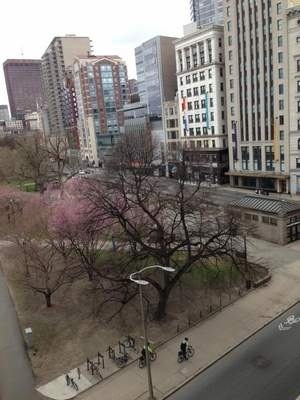
GREAT FALLS NATIVE RECALLS AFTERMATH OF BOSTON BOMBING

The view from Sara Graybill's dorm room at 9:30 a.m. on the Emerson College campus in downtown Boston. Courtesy photo

Emerson College Freshman Sara Graybill lives just three blocks away from the site of the Boston Marathon bombings. She gave this interview to Great Falls KRTV last week and was the subject of this article in the Great Falls Tribune.

CHICKEN SOUP CHALLENGE

Well, we’ve had the battle of the Matzoh Brie and the brisket, and the what-makes-the-best-latkes debate. Inspired by Student Rabbi Miriam Farber’s sermon, I thought it might be fun to propose a Chicken Soup Challenge. What makes the best Jewish penicillin, that stuff of legend and lore? How do you get that great chicken flavor, that perfect texture, that delicate balance of vegetables and herbs and flavorful broth, that steaming bowl of goodness memories are made of and rhapsodic essays are written about, the comfort kids come home to from far flung places, the tried-and-true recipe that brings a tear to many a young bride’s eye when her husband says, “That’s not how Mom used to make it.” Please submit your top secret recipes. We promise we’ll keep them to ourselves.

Joy Breslauer, editor@aitzchaim.com

AFTER DEATH … HOLINESS

EDITOR’S NOTE: This is the timely and insightful sermon which Student Rabbi Miriam Farber gave on Friday evening, April 19, repeated here for the benefit of the few who were there, and of the many who unfortunately were not there.

The local bookstore might be an endangered species, replaced by Amazon and e-books. But, if you find yourself in a Barnes and Noble, or even, imagine, an independent bookstore, somewhere in that shop is a shelf filled with Chicken Soup for the fill-in-the-blank Soul. Chicken Soup for the Teen Soul, Chicken Soup for the Jewish Soul, Chicken Soup for the Nurse’s Soul, Chicken Soup for the Cancer Survivor’s Soul – the list of titles goes on and on. Chicken soup, that delicious Jewish penicillin, able to fix any ailment, physical or emotional, is now available in book form to provide sustenance, inspiration, and healing.

There are so many places to turn to when we need comfort. As Jews, as the People of the Book, chicken soup in book-form makes sense. Our own sources – the Torah, the prayerbook, the libraries full of the Jewish wisdom of the ages – provide comfort and healing. When we said Mi Shebeirach a few moments ago, we drew strength from the Torah itself. Chicken soup in its literal form makes sense to us too. Comfort food, whether it is chicken soup, mashed potatoes, ice cream, or whatever dish works for you, is a physical response to our emotional pain. On Monday afternoon, after a harrowing day of watching the news and avidly scanning social media, waiting for my friends in Boston to check in – I turned off the TV, went into the kitchen, and felt calmer making dinner than I had all day.

Our tradition offers us many options for how to respond at times of tragedy and trauma, whether a personal loss or a shared communal event. We have prayers and mourning rituals, and we seek the wisdom of those throughout our history who have struggled with the same questions and struggles we face now.

Our double Torah portion this week is called Acharei Mot-Kedoshim. Acharei Mot occurs immediately after the death of Aaron’s sons. The opening words of the portion, which give the parasha its name, mean, “After the death.” The other half of our double parasha, Kedoshim, falls at the center of the Torah. It consists of the Holiness Code, two chapters filled with laws guiding us in our human relationships. The Holiness Code lays out how to build a holy society. The word Kedoshim means holy, appearing at the beginning of Leviticus 19: Kedoshim tihyu – You, the people of Israel, shall be holy.
Acharei Mot-Kedoshim. After death…holiness. After moments of trauma and fear, our tradition teaches us, through the juxtaposition of these two portions, that we must respond with acts of holiness and kindness towards our neighbors, towards strangers, to continue to build a holy society, even at the time when that holiness seems least attainable.

The stories of acts of kindness in the past several days have almost blocked out the blackness of Monday’s tragedy. First responders, including medical personnel who only expected to treat dehydrated runners, ran towards the explosions, saving countless lives. They took to heart the words we find in our Torah portion this week, “Lo ta’amod al dam rei’echa – do not stand idly by the blood of your neighbor.” Marathon runners, physically exhausted from the exertion of running 26 miles, kept on running past the finish line, to give blood at Boston’s hospitals, embodying the value that pikuach nefesh, saving a life, takes precedence over everything else. Over one thousand Boston residents opened up their homes to host marathon runners from all over the world who found themselves without a place to sleep on Monday night. These generous hosts taught us what it might mean to fulfill the commandment, “When a stranger resides with you in your land, you shall not wrong him…you shall love him as yourself, for you were strangers in the land of Egypt.” ’doshim tih’yu ki kadosh ani Adonai Eloheichem. You shall be holy, for I, Adonai your God, am holy. Our human capacity to do holy acts is a result of our creation b’tzelem Elohim, in the image of God.

Earlier tonight, in the Gevurot, we praised God as the someich noflim – the Lifter of the fallen and as the rofei cholim – the Healer of the sick. We credit God with these acts of kindness, but perhaps God acts through us, through the human hands that reach out to lift someone off the ground, through the wisdom of human doctors and nurses, through the human arms that embrace the person who just needs an understanding hug, through the human shoulders upon which the bereaved cry.

The Talmud teaches, “Just as God clothes the naked, so should you; just as God visited the sick, so should you, just as God comforted the mourners, so should you; and just as God buried the dead, so should you.”

Rabbi Shai Held adds, “Just as God is present when people are vulnerable and suffering, so should we be.” We are holy when we act in the ways that God acts, when we run to do our small part to build a holy civilization.

What does it mean for us to be present with suffering, to run towards tragedy, rather than in the opposite direction? For us, this week, it doesn’t need to mean getting on the next flight to Boston or West, Texas, or being glued to the unceasing news coverage that has marked this week. Instead, perhaps the way that we become kedoshim, holy, is through remembering that our holy acts are needed all the time, not only at times of national tragedy. Kedoshim offers two chapters full of ideas for bringing God’s holiness into the world every day, starting with honoring one’s parents and celebrating Shabbat.

Rabbi Rachel Barenblat teaches us what this might look like, writing, “God is in the friend who offers to hold a newborn so its exhausted mother can take a shower and get some sleep. God is in those who gather for shiva so the mourner can say kaddish in the presence of a minyan. God is in the friend who makes a pasta salad and brings it to the home of a woman whose husband has slipped a disc and can’t get out of bed. God is in the parent who rocks a sick child in the middle of the night. We find God in our acts of love for one another.”

These everyday acts of kindness bring God into the world, healing, slowly, our brokenness. Kedoshim is the Torah portion at the very center of the Torah. And at the very center of Kedoshim is the most simple, yet most difficult commandment: V’ahavta l’reyacha kamocha – Love your neighbor as yourself. Rabbi Hillel taught that this verse is the ENTIRE Torah – all the rest is commentary. The rest of the Torah teaches us how to love our neighbors, giving us concrete tasks to do, whether at a time of tragedy or on any old Thursday, those tasks of caring for the sick and feeding the caregivers, of being present with people when they are most vulnerable.

Rabbi Yitz Greenberg, in an essay in which he struggles with belief in God after the Holocaust, declares, “Faith is living life in the presence of the Redeemer, even when the world is unredeemed.” Rabbi Greenberg suggests that there might be moments of redemption, even if we have not yet achieved a complete redemption for the entire world. Even at our darkest moments, when we lose our faith in humanity, in God, and in ourselves, we still hold onto the belief that redemption is possible, and even near. We search for those moments of redemption, sparks of light and hope that illuminate the dark night of helplessness and despair.

May we reach beyond our own brokenness and pain to make God’s presence felt in our world, by using our hands to ease the pain of the sick, our words to comfort the suffering, and our ears to listen to the voices of the scared. Y’varcheinu Adonai v’yish’m’reinu – May God bless us and protect us.
A MOTHER’S WISDOM IN SCHUL

EDITOR’S NOTE: Since we are having a visit from Student Rabbi Miriam Farber this week end, I thought I’d include this little informational tidbit.

After Sabbath services were over, Rabbi Cohen is met at the shul door by Golda and her young son Sheldon.

“Rabbi,” says Golda, “I’m sorry my Sheldon was so noisy during your sermon.”
“That’s OK, Golda,” says Rabbi Cohen. “Rabbis are also parents and we understand the problem. But do tell me: how you managed to get him to keep quiet.”

“It was quite easy rabbi,” replies Golda. “Fifteen minutes into your sermon, I leaned over to Sheldon and whispered in his ear, ‘Sheldon, listen to me carefully. If you don’t stop making such a noise, Rabbi Cohen is going to lose his place in his sermon, and if he looses his place, he will have to start his sermon all over again!’

Student Rabbi Miriam Farber will be here this weekend! Mark your calendar for a Great Falls ‘Jewish Weekend!’

As Joy noted last week, Student Rabbi Miriam Farber will be here in a few short days; it has been too long since we have gathered for services.  

  • Kabbalat Shabbat services will be held at the Bethel on Friday, April 19 at 7:30 pm.
  • Torah Study will be held at the Bethel at 10am on Saturday, April 20.
  • Our NFTY (National Federation of Temple Youth) will also be meeting on Saturday afternoon.  Contact Rabbi Miriam if you need more information about this meeting.
  • We will gather for an adult discussion at the Bethel on Saturday evening, 5:30 pm.  This will also be a vegetarian/milchig potluck meal.  Please bring a dish to share!

We look forward to seeing you at our services!

URJ: INTERGENERATIONAL SURVEY OF THE AMERICAN JEWISH COMMUNITY

We invite you to participate in an important new intergenerational survey of the American Jewish community.

This national survey was created by Dr. David Elcott, the Henry and Marilyn Taub Professor of Practice in Public Service and Leadership at New York University’s Wagner Graduate School of Public Service, and Stuart Himmelfarb, CEO and co-founder of B3/The Jewish Boomer Platform. Please note that all responses are confidential.

Your responses will help us better understand people’s attitudes, activities and plans.

The survey covers all four adult generational groups (Millennials, Gen X-ers, Boomers and WWII/Greatest), so if you’re over 18, we hope to hear from you.

Please go to https://www.research.net/s/F682HKD, to take the survey.

We think you will find the survey interesting and quick; we know it will be a helpful new resource for us all. We also encourage you to share the link with members of your community to gather a wider sample from which to learn about the various generational groups.

Thank you!
Rabbi Victor S. Appell
Congregational Marketing Director
Union for Reform Judaism
212-650-4144